European Web Analytics: A Privacy-First Buyer’s Guide
Compare European web analytics tools by privacy design, data location, reporting needs, and implementation effort to choose a practical GA4 alternative.

Written by Kevin Christensen

European web analytics can give you useful traffic data without defaulting to a surveillance-heavy setup. The right choice depends on what you need to measure, where the provider processes data, and how much implementation work your team can support.
EuroToolKit’s European web analytics directory is a practical place to start. It includes simple hosted dashboards, self-hosted options, and more advanced platforms. This guide helps you narrow that list without treating a tool choice as legal advice or a substitute for your own privacy review.
Start with the measurement job
Before comparing dashboards, write down the decisions analytics must support. A content-led business may only need top pages, referrers, campaign traffic, and a few conversion events. A product team may need funnels, event properties, or a way to join analytics with first-party product data.
That distinction matters because a feature-rich implementation can create more work than insight. Start with a short list:
- Which pages or campaigns should improve?
- Which actions count as a meaningful conversion?
- Do you need aggregate trends, or individual session-level analysis?
- Who needs access, and how will you prevent sensitive data from entering URLs or event properties?
- Is a hosted service acceptable, or does your policy require self-hosting?
If your main goal is reporting site traffic, simpler tools are often easier to govern. If marketing depends on attribution, experimentation, or several data sources, plan the data model and consent approach before you add another script.
Compare privacy design, not just labels
“Cookieless” is a useful technical description, but it is not a universal compliance verdict. Check what a tool places on a device, what it receives at collection, whether it creates persistent identifiers, how long it retains data, and what optional features change those answers.
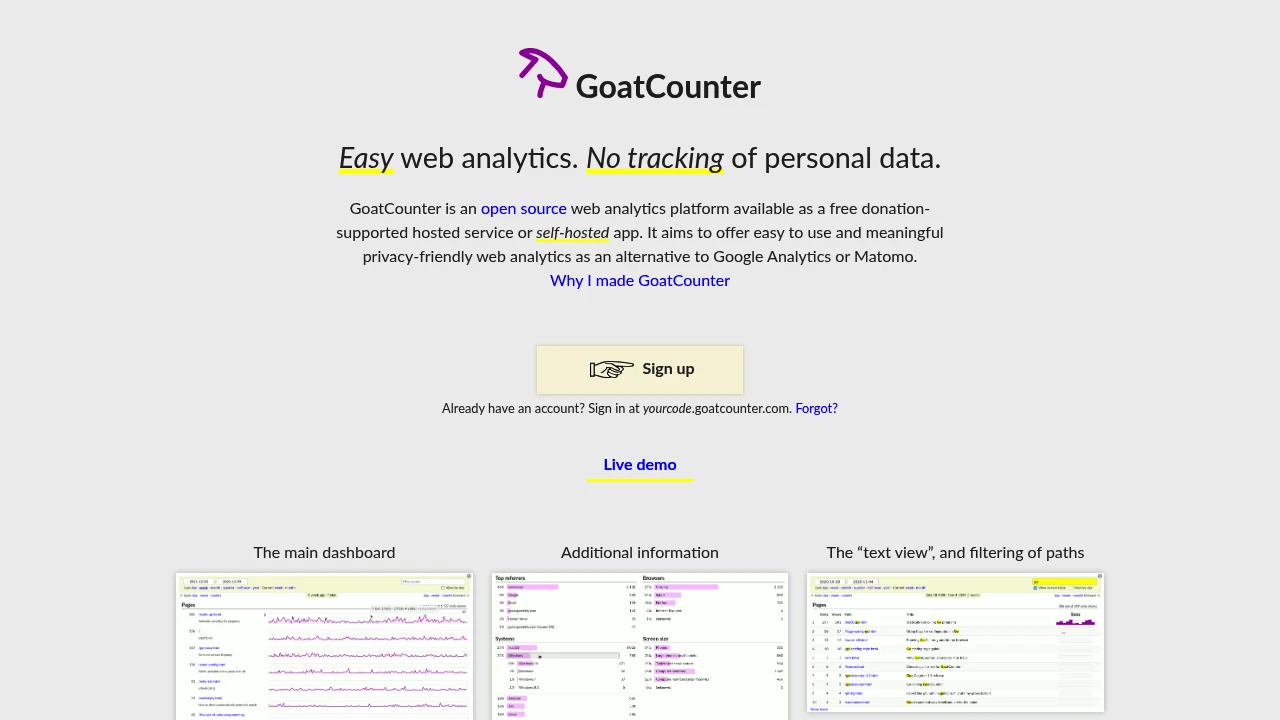
For example, Plausible’s data policy says its hosted service does not use cookies or persistent identifiers and processes visitor data in the EU. GoatCounter’s privacy documentation explains that its default reports are aggregated, while individual-pageview collection is an optional setting. Those implementation details are more useful than a generic “GDPR compliant” badge.
You should also review your own configuration. Custom events can accidentally contain email addresses, order references, search terms, or other personal data. A privacy-friendly analytics product cannot undo data that your site sends to it.
Three tools for different starting points
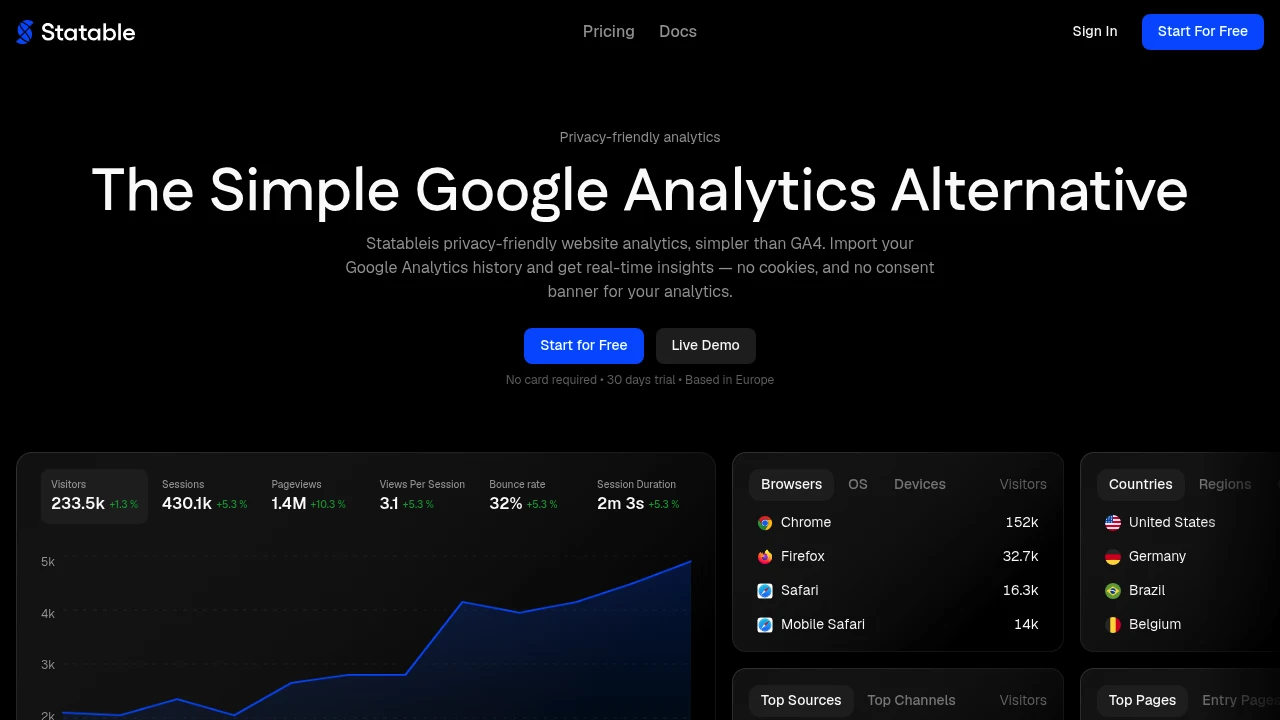
These verified EuroToolKit listings illustrate three different approaches. They are examples, not a legal ranking.

Plausible and GoatCounter are both available as hosted services or self-hosted software. Plausible’s self-hosted version is called Plausible Community Edition. Plausible’s policy for its managed cloud service says that visitor data stays in the EU on European-owned infrastructure. Statable states that it operates from the Netherlands and describes a cookieless design, while GoatCounter documents hosting in Finland and Germany for its hosted service. Confirm the current contract, subprocessors, and hosting terms for the option you will actually use. Those details can change, and self-hosting shifts responsibility for installation, security, backups, upgrades, uptime, and retention to your team.
Check data location and buyer controls
Provider jurisdiction and server location are useful starting points, but they are only part of a buyer review. Ask for the data processing agreement, current subprocessor list, retention and deletion terms, export options, and account-security controls. For a larger team, also check roles, audit logs, single sign-on, and whether access can be limited to the people who need it.
Use a small proof of concept before migrating. Add the new script to a controlled site or a subset of pages, then compare its counts with your existing analytics. Differences do not automatically mean either tool is wrong. Cookie consent, ad blockers, bot filtering, timezone settings, and differing visitor definitions can all change totals.
If your site also uses forms, advertising pixels, a CRM, or a customer-data platform, review those separately. Replacing one analytics script does not remove the obligations created by the rest of the stack.
Plan the migration around decisions
A clean migration is usually more valuable than importing every old report. First, document the pages, campaigns, and conversions that guide weekly decisions. Then map only those items into the new tool.
For a content site, that might mean pageviews, referrals, search landing pages, newsletter traffic, and outbound-link clicks. For a SaaS business, it might mean trial starts, activation steps, and paid conversions. Define event names before launch and keep them stable, so reports remain useful over time.
You can also use the migration to remove noisy events and query parameters. Keep a short change log with the script date, consent configuration, timezone, and known reporting differences. This makes it easier to explain a sudden chart change later.
For broader infrastructure questions, EuroToolKit’s guide to European alternatives to Google Cloud covers different trade-offs around hosting and provider choice. Its guide to choosing compliant software for an EU business is a useful companion when you are building a wider supplier-review process.
Choose the smallest setup that answers your questions
European web analytics is not about collecting less data for its own sake. It is about collecting enough information to make better decisions while keeping the design understandable for your team and respectful of visitors.
Start with the questions you need to answer next month. If you need to know which pages attract readers and which campaigns create signups, a focused dashboard with a handful of well-defined events may be enough. If you need detailed product analysis, choose that capability deliberately and budget for the implementation, access controls, and review work it requires.
Then test the real workflow. Install the tool on a limited scope, verify that traffic sources and conversions make sense, and inspect exactly what data your site sends. Read the provider’s current DPA, privacy documentation, hosting statement, and subprocessor information rather than relying on a sales page or an old comparison.
Finally, keep the legal boundary clear. A European provider, EU hosting, or cookieless configuration can support compliance work, but none of those facts makes a specific deployment automatically compliant. Your organization still needs to assess its purposes, lawful basis, notices, data minimization, contracts, and the other services on the site. The best analytics choice is the one your team can explain, operate, and review with confidence.
 SparkReceipt — Never lose another receipt. Get your bookkeeping down to ten minutes a month.